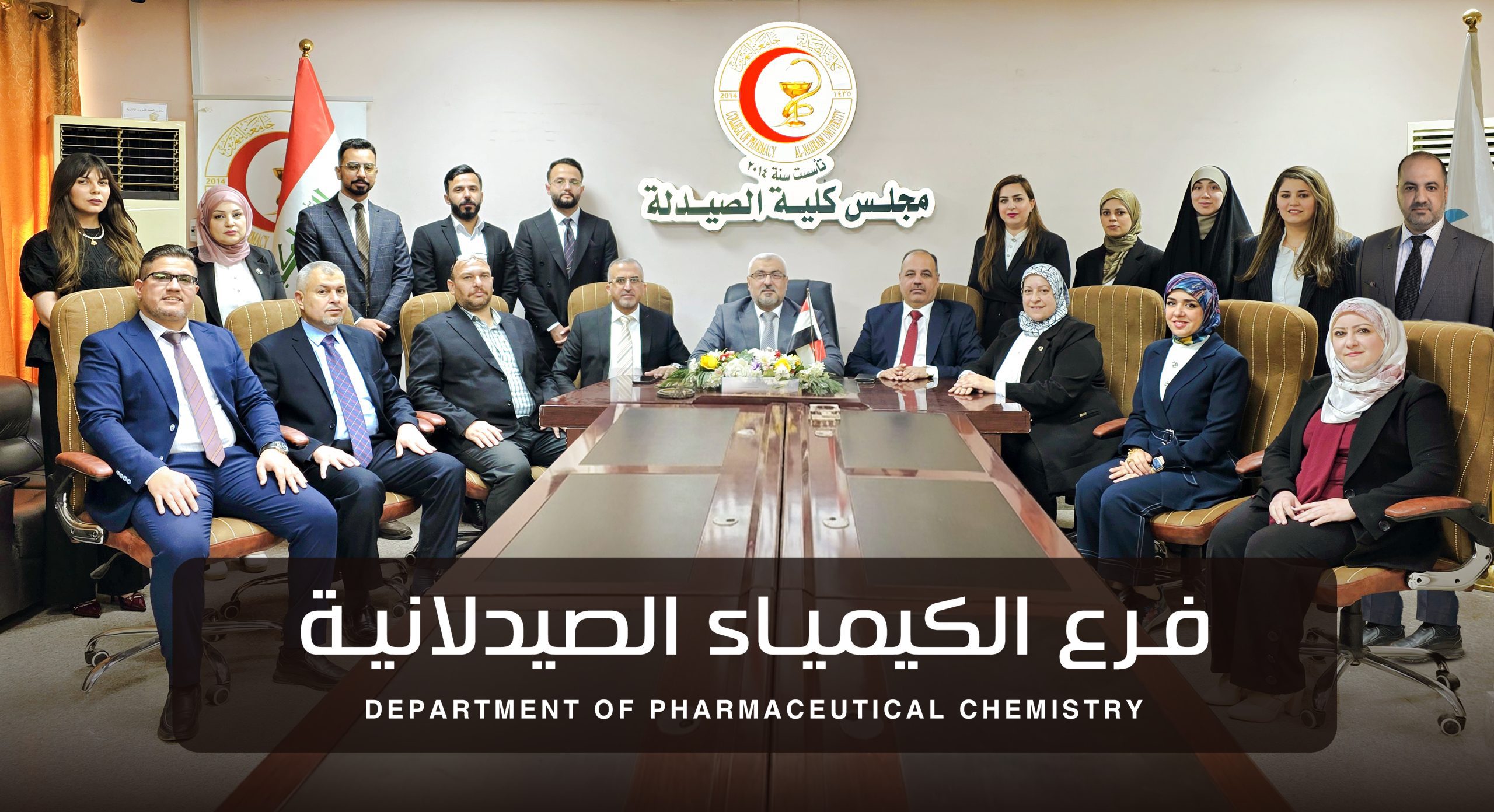
Department of Pharmaceutical Chemistry
An in-depth study of the chemical structure of drugs and their mechanisms of action across five academic years, preparing experts in the design and analysis of effective drug compounds.
Vision & Mission
Vision
To lead in pharmaceutical chemistry research and development, and to prepare pharmacists who understand drug molecules and how to invent and develop new therapeutic compounds that serve the pharmaceutical industry and scientific research.
Mission
The department’s mission is to provide distinguished academic and research education that combines chemical principles with pharmaceutical applications, to equip students with the laboratory skills needed to prepare and analyze drugs, and to contribute to the development of the national industry.
About the Department
The Department of Pharmaceutical Chemistry is one of the core academic and research pillars of the College of Pharmacy at Al-Nahrain University. It studies the chemical aspects of pharmaceutical compounds, including their design, synthesis and analysis, and the molecular mechanisms through which they act. The department aims to prepare pharmacists and researchers with a solid scientific foundation that links the chemical sciences to pharmaceutical and industrial applications.
The curriculum is distributed across the five years to cover the knowledge and practical requirements in the following areas:
Organic Chemistry: the study of organic compounds, their reactions and their nomenclature (IUPAC), as the foundation for building and understanding drug structures.
Pharmaceutical Organic Chemistry: the design and synthesis of drugs, including the creation of new drug compounds and the study of the relationship between chemical structure and biological activity (SAR).
Advanced Pharmaceutical Analysis: the use of manual techniques and modern instruments (such as chromatography and spectroscopy) for drug quality control and purity testing.
Academic Track and Scientific Research: pursuing postgraduate studies (Master’s and PhD) and contributing innovative research to the scientific library that serves the research and industrial environment.
Program Objectives
Prepare graduates who understand the chemical mechanisms by which drugs act inside the body.
Qualify students to work in drug control and quality control laboratories.
Develop scientific research skills in the synthesis and development of natural and synthetic products.
Strengthen knowledge of modern analytical techniques to ensure drugs comply with international specifications.
Curriculum
| Course | Semester | Units |
|---|---|---|
| Analytical Chemistry | First Semester | 4 Units |
| Organic Chemistry I | Second Semester | 4 Units |
| Course | Semester | Units |
|---|---|---|
| Organic Chemistry II | First Semester | 4 Units |
| Organic Chemistry III | Second Semester | 3 Units |
| Course | Semester | Units |
|---|---|---|
| Inorganic Pharmaceutical Chemistry | First Semester | 3 Units |
| Organic pharmaceutical chemistry I | Second Semester | 4 Units |
| Course | Semester | Units |
|---|---|---|
| Organic pharmaceutical chemistry II | First Semester | 4 Units |
| Organic pharmaceutical chemistry III | First Semester | 4 Units |
| Course | Semester | Units |
|---|---|---|
| Organic pharmaceutical chemistry IV | First Semester | 2 Units |
| Advanced Pharmaceutical Analysis | Second Semester | 4 Units |
Academic Program Description
An educational program is a set of carefully planned courses that include procedures and experiences arranged in the form of an academic curriculum. Its main aim is to improve and build graduates’ skills so that they are ready for the job market, and it is reviewed and evaluated every year through internal and external audit procedures.
Teaching Staff
Demonstrators
Department Laboratory
Pharmaceutical Chemistry Laboratory
View the laboratory’s details, instruments and equipment on its dedicated page.
Views: 26